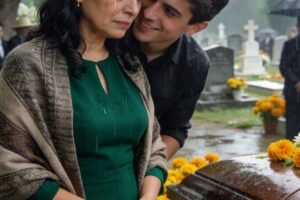
The sharp sound of heels echoed across the marble floor, too loud, too cold, completely out of place. Every head turned. The sound ricocheted off the high ceilings and the stained glass and the polished pews, and it carried with it something that had no business being in a place like this, something almost triumphant.
Not slowly. Not respectfully. Not even attempting to perform grief for the benefit of the room. He strode down the aisle like a man arriving at a celebration, his suit perfectly tailored, his hair neatly styled, his chin up at an angle that said he had decided this room and everyone in it was beneath his concern. On his arm was a young woman in a bold red dress, smiling with the easy confidence of someone who had no idea where she was standing or what that coffin meant or who was inside it.
The room shifted. Whispers spread in waves from the front pews to the back. Someone gasped. A woman near the aisle put her hand over her mouth. The priest stopped mid-sentence, his place in the liturgy dissolving into the sudden heavy silence of a room that could not look away.
“Traffic downtown is terrible,” he said casually, dropping the words into the silence the way someone drops a coat on a chair, thoughtlessly, without looking to see if anything is already there.He wasn’t apologizing. He was explaining his own tardiness as if the inconvenience was ours.
He didn’t pause. He simply adjusted his cufflinks, glanced briefly at the coffin, and let his gaze sweep the room with the faintest trace of amusement, as though he were surveying a gallery of curiosities rather than a congregation gathered to mourn. The young woman on his arm laughed softly at something he whispered, a sound that cut through the grief like glass.
Eyes followed him, some filled with anger, others with disbelief, all silently questioning why someone could move through a place of loss with such indifference. The organist faltered, and a few notes lingered awkwardly in the air. The air itself seemed to stiffen, waiting for someone—anyone—to restore order, to demand that the audacity stop.
He stopped only at the third pew, just short of the center aisle, and finally looked directly at the family. His lips curled into a smile that didn’t reach his eyes. “Would anyone like a program?” he asked, the casualness of the question a razor edge against the tension in the room. Murmurs rose, and then a sharp cough from the back reminded everyone that the world, somehow, had not yet collapsed under his defiance.
And then he sat. Not gently. Not respectfully. But as if the room existed to receive him, not the other way around. The funeral, once solemn and sacred, had shifted. And in that shift, it became clear: he had not come to mourn. He had come to assert that even in the face of death, he remained unshakable.